How the industry's most demanding builders are rethinking a part of the bait system nobody used to talk about.
There's been a change happening offshore.You don't see it in marketing. You see it in what builders are choosing to put inside boats.
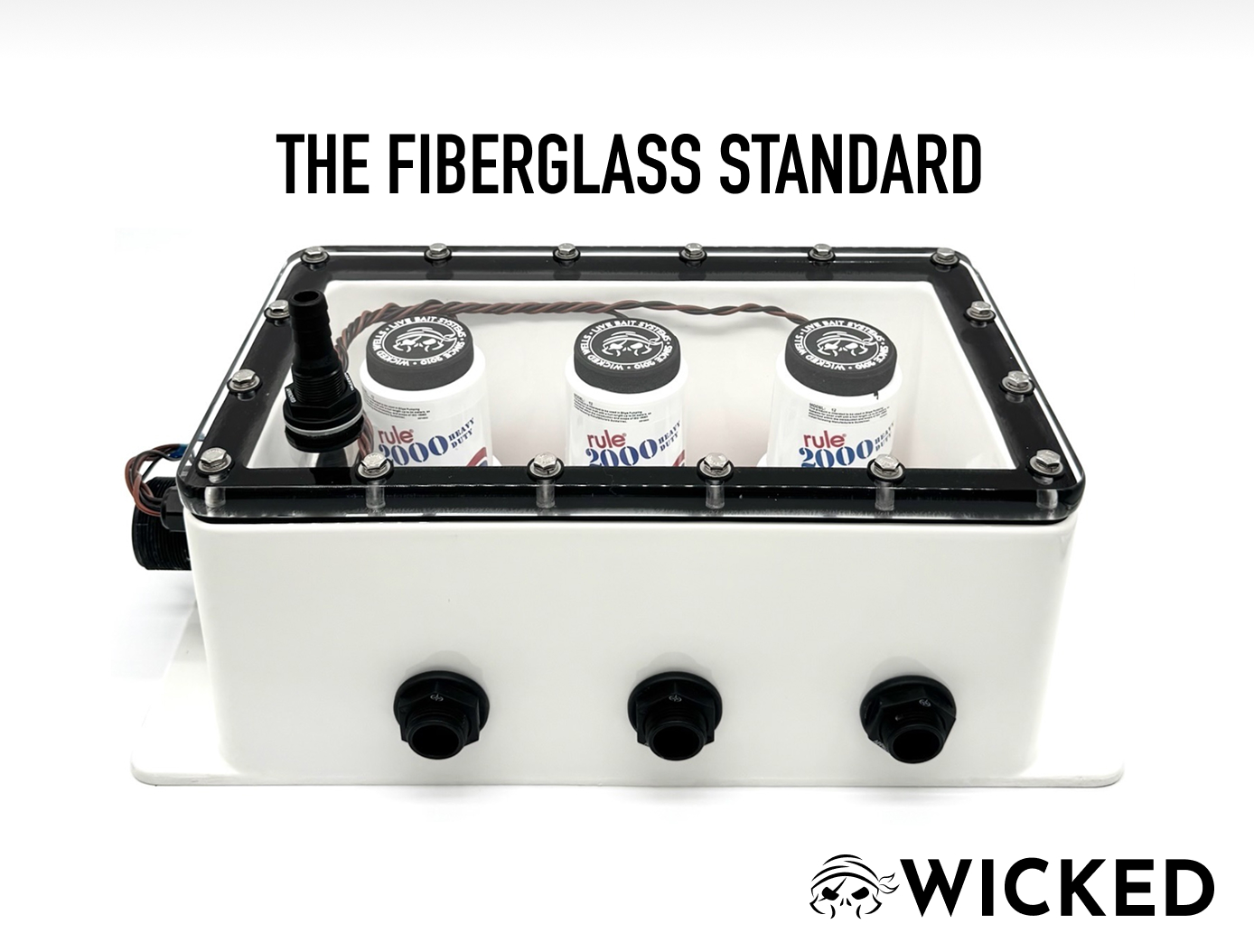
Over the last several months, Wicked fiberglass pump boxes were specified on four new builds — the Front Runner 35, Freeman 32, Solace 42 CS, and Queen Custom 52.
These are builders known for setting the benchmark in their respective markets: performance-obsessed craftsmen whose customers expect the boat to perform at the highest level, in the hardest conditions, for a long time.
Different shops. Different crews. No coordination between them. But all came to the same answer.
Pump boxes used to be an afterthought.
Thru-hull, Mount the pump in line - Move on. That worked for a long time. But the boats these builders are making aren't the same anymore — and neither are the expectations of the people buying them.
Higher speeds. More sophisticated water systems. Customers who fish hard and notice everything. At this level of build, there's no tolerance for a component decision early in the process that creates a problem you're managing later.
So builders like these are looking harder at the parts of the system that used to get less attention.
What actually happens to the water in your bait system
This is where it gets specific — and where a lot of people don't fully connect the dots.
When you have mixed metals in a saltwater system — aluminum or stainless boxes, bronze fittings, copper connections — you've got galvanic activity happening whether you planned for it or not.
Dissimilar metals in an electrolyte (and saltwater is a very good one) create a circuit. The less noble metal corrodes. Ions bleed into the water.
To manage that, builders add zinc anodes. Which works — for corrosion protection. But now you've got zinc dissolving into the system by design. You've introduced a metal into your bait water to offset the damage being done by other metals.
Even in systems without sacrificial zincs, you're dealing with low-level ion contamination upstream. It doesn't show up as a dramatic event. It shows up as bait that's a little more stressed, a little less lively, a little harder to keep through a long run. The kind of thing that's easy to blame on water temperature or handling — until you run a cleaner system and notice the difference.
Fiberglass is inert. There's nothing in it to corrode, nothing to leach, nothing interacting with the water moving through the system. What goes in comes out the same.
The same thinking that changed livewells
Most guys in this industry remember when fiberglass livewells were still a preference. At some point, they just became the standard — because the long-term performance math was obvious. This is the same logic, one step back in the system.
If the box feeding the system is right, everything downstream has a better shot — including the bait.
When builders like these land in the same place independently
These are builders who sweat every detail. They've forgotten more about saltwater systems than most people will ever learn. They're not chasing trends and they're not making spec decisions based on a sales conversation. When four of them — independently — arrive at the same answer on pump box material, it's worth paying attention to.
One builder switching is a preference. Four builders at this level all landing in the same place on their own is a signal about where the industry is heading. Less risk. Less maintenance. Better performance where it actually counts — including what's swimming in your wells.
Want to learn more or see a box for yourself? Come see us at Palm Beach Boat Show.